
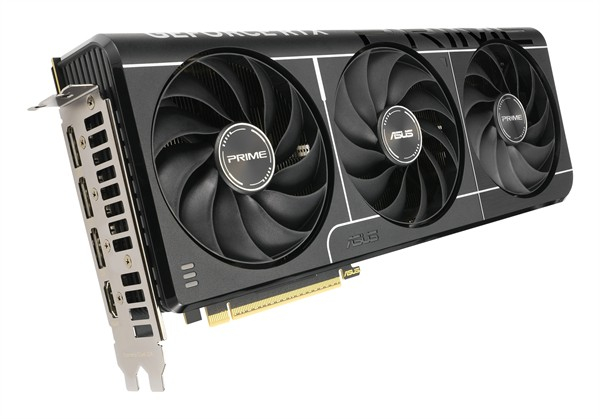
ASUS Prime GeForce RTX 5070 Ti OC/PRIME-RTX5070TI-O16G/16GB GDDR7/HDMI/3x DP
Speicher: 16GB GDDR7, 256bit, 28Gbps, 1750MHz, 896GB/?s
Takt Basis: 2300MHz (Standard-Profil)
Takt Boost: 2497MHz (Standard-Profil), 2527MHz (OC-Profil)
Übertaktung: +77MHz Boost (OC-Profil), +47MHz Boost (Standard-Profil)
Kühlung: 3x Axial-Lüfter (90mm) mit 0dB-Zero-Fan-Modus (bis 55°C)
TDP/TGP: 300W (NVIDIA)
Stromanschlüsse: 1x 12V-2x6 (via Adapter: 3x 8-Pin PCIe)
Anschlüsse: 1x HDMI 2.1b, 3x DisplayPort 2.1b UHBR20
Anbindung: PCIe 5.0 x16
Info: Backplate, Dual BIOS Switch, AI-Beschleunigung, Taktprofile (Default Mode/OC Mode), NVIDIA GeForce SFF-Ready
Gesamthöhe: Triple Slot (2.5 Slots)
Abmessungen: 304x126x50mm (LxBxH)
Bauform: PCIe-Karte (full height)
Slotblende: full height
AI-Rechenleistung (dense): 703 TOPS (FP4), 351.5 TOPS (FP8), 175.75 TOPS (FP16)
AI-Rechenleistung (sparse): 1406 TOPS (FP4), 703 TOPS (FP8), 351.5 TOPS (FP16)
GPU-Rechenleistung: 44.80 TFLOPS (FP16), 44.80 TFLOPS (FP32), 0.70 TFLOPS (FP64)
Chip-Architektur: NVIDIA Blackwell (ab 2025/?Q1)
Chip-Bezeichnung: GB203 (GB203-300-A1)
Chip-Ausbau: 83.3% aktive Recheneinheiten (70/?84 SM)
Chip-Konfiguration: 70SM (8960SP/?280TMU/?96ROP), 70 RT-Cores, 280 Tensor-Cores, 48MiB L2-Cache
Chip-Fertigung: TSMC N5P [NVIDIA 4N] (5nm)
Chip-Größe: 378mm², monolithisch, 45.6 Mrd. Transistoren
Chip-Funktionen: Raytracing (4th Gen NVIDIA RTX, 133 TFLOPS), NVIDIA Tensor (5th Gen, 175.75 TOPS), HDCP 2.3
Chip-Verwendung: GeForce RTX 5080, GeForce RTX5070 Ti, RTX PRO 4500 Blackwell, RTX PRO 4000 Blackwell
API-Unterstützung: DirectX 12 Ultimate (12_2) /? CUDA 12.8 /? Vulkan 1.3 /? OpenCL 3.0 /? OpenGL 4.6 /? Shader Model 6.8
Transcoding-Engine: 2x NVENC (9th Gen, max. Sessions: 8), 1x NVDEC (6th Gen)
Encoding: AV1 (YUV 4:2:0), H.265 (4K YUV 4:2:0 /? 4K YUV 4:2:2 /? 4K YUV 4:4:4 /? 4K Lossless /? 8K /? HEVC 10bit support /? HEVC B Frame support), H.264 (YUV 4:2:0 /? YUV 4:2:2 /? YUV 4:4:4 /? Lossless)
Decoding: AV1 (8bit /? 10bit), H.265 (8bit 4:2:0 /? 10bit 4:2:0 /? 12bit 4:2:0 /? 8bit 4:2:2 /? 10bit 4:2:2 /? 8bit 4:4:4 /? 10bit 4:4:4 /? 12bit 4:4:4), H.264 (8bit 4:2:0, 10bit 4:2:0, 8bit 4:2:2, 10bit 4:2:2), VP9 (8bit /? 10bit /? 12bit), VP8, VC-1, MPEG-2, MPEG-1
